
Beyond Tick-Box Compliance: Executive Leadership Under the Standards for RTO’s 2025
The Vocational Education and Training (VET) sector in Australia stands at a pivotal threshold. The rollout of the Standards for RTOs 2025 framework by the Australian Skills Quality Authority (ASQA) represents more than a legislative refresh—it demands a fundamental cultural transformation in how Registered Training Organizations (RTOs) manage quality, assessment, and governance.
For years, many providers operated under a reactive, “tick-box” compliance model. Policies were written for the regulator, evidence was gathered hastily prior to an audit, and continuous improvement registers were treated as static administrative burdens.
BOOK NOW:
Under the 2025 framework, that era is officially over. ASQA’s move toward outcome-focused, evidence-based self-assurance requires executive leaders, CEOs, and quality teams to demonstrate systemic operational health and verified training impact.
The Four Pillars of Outcome-Focused Self-Assurance
To thrive in this new regulatory climate, RTO executive teams must embed continuous monitoring across all four core Quality Areas:
1. Training & Assessment Systems (Quality Area 1)
Compliance can no longer be proven by presenting blank assessment master tools or generic Training and Assessment Strategies (TAS). RTOs must demonstrate active industry engagement that directly shapes assessment design, equipment selection, and delivery pacing. Furthermore, systematic pre-use and post-use validation cycles must evaluate actual completed student work to verify marking reliability across all assessors and delivery locations.
2. Learner Support & Protection (Quality Area 2)
Self-assurance requires proactive identification of learner needs prior to enrollment. LLND diagnostic screening, transparent fee structures, and structured reasonable adjustments must be embedded into the learner journey. Where third-party recruiters or workplace hosts are utilized, the RTO must maintain strict oversight and contractual enforcement.
3. VET Workforce & Credentials (Quality Area 3)
The 2025 Credential Policy places dual demands on trainers and assessors. Holding a TAE qualification is merely the baseline; personnel must prove active, ongoing vocational currency in the specific units they deliver. RTOs must implement active return-to-industry placement mechanisms and structured VET professional development.
The ultimate measure of an RTO’s maturity lies in its ability to self-correct. Outcome Standard 4.4 requires continuous improvement loops that do not merely log issues, but actively perform Root-Cause Analysis (using tools such as the 5-Whys methodology) and verify that corrective actions have achieved their intended impact.
Moving From Reactive to Proactive: The Self-Assurance Maturity Curve
At Innovation Education Australia, we evaluate RTO operational capability across three primary maturity stages:
4. Governance & Self-Assurance (Quality Area 4)
1. Level 1: Reactive (Ad-Hoc): Systems are fragmented. Continuous improvement occurs only after major non-compliance’s, student complaints, or regulatory audit warnings.
2. Level 2: Compliant (Tick-Box): Documentation is aligned on paper, but operational practice is inconsistent. Internal audits focus on template completion rather than evidence sampling.
3. Level 3: Proactive (Self-Assured): Data-driven monitoring is embedded in daily workflows. Executive leadership receives regular self-assurance reporting, validation findings are systematically remediated, and quality is treated as a strategic market advantage.
Empowering Your Team with Turnkey Capability
Building an outcome-focused culture requires equipping your leadership and compliance teams with practical, pre-validated operational tools.
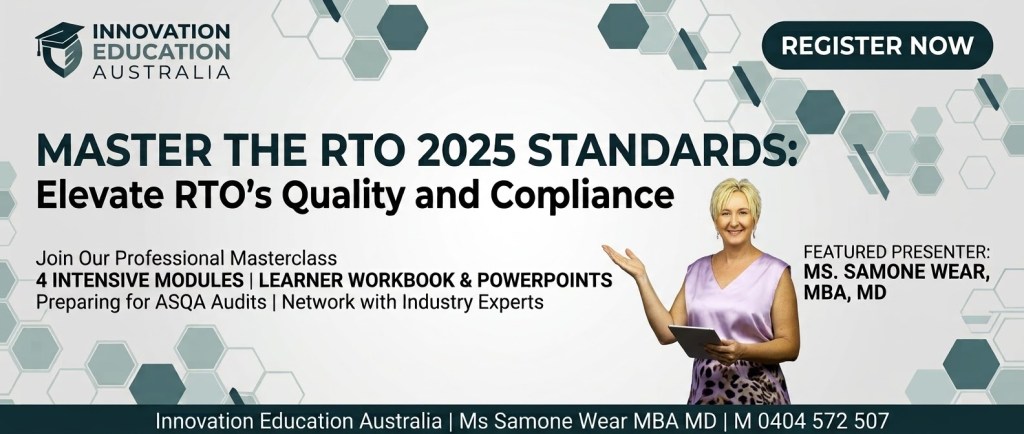
To support RTO directors, CEOs, and quality teams through this transition, Innovation Education Australia has released the Masterclass in RTO Quality & Compliance (Standards 2025 Framework).
Delivered through interactive face-to-face workshops across South East Queensland and virtual cohorts nationally, this program provides:
- Word-ready Executive Diagnostics Suite (Scope, Risk, and Maturity tools).
- Hard copy and digital audit tool kits for live student file sampling.
- Root-Cause Analysis (5-Whys) worksheets and validation logs mapped to 2025 metrics.
- Complete Excel-ready Continuous Improvement, Trainer Matrix, and Third-Party Oversight registers.
Take the Next Step in Regulatory Readiness
Ensure your executive team and quality leaders possess the tools, knowledge, and capability to navigate the Standards for RTOs 2025 with complete confidence.
Quality management is no longer an administrative obligation—it is the foundation of organizational sustainability and educational excellence.
RTO 2025 Implementation Pathway
Evolve and transform key talent assets: Business-as-usual-owners
Delivery & Deployment: Facilitation of the program (In-House F2F, Virtual, or Public) followed by immediate roll out of the turnkey self-assurance suite.
Strategic Consultation: A 30-minute scope alignment discussion with Ms. Samone Wear to review your RTO’s specific profile and self-assurance objectives.
Pre-Workshop Audit Sample: Selection of anonymised TAS documents and assessment files for practical, live validation during the masterclass.
Facilitated by Ms Samone Wear, MBA MD I Innovation Education Australia TM

